Wildlife Spotting Guide for Rathgama Lake
By AquaTrek · Hikkaduwa locals
Rathgama Lake is one of the richest wildlife habitats on Sri Lanka's south coast. The lagoon sits at the intersection of several ecosystems — brackish open water, dense mangrove forest, freshwater channels, and the coastal ocean — which means it supports an unusually diverse range of species for its size. Over 50 bird species have been recorded here, along with monitor lizards, macaque monkeys, fruit bats, and the traditional fishermen who have worked this water for generations.
This guide covers the species you are most likely to encounter on a kayak tour, when to see them, and what to look for.
Kingfishers — The Stars of the Mangrove Channels
Three kingfisher species are regularly seen on Rathgama Lake, and the mangrove sections of the tour are where you find them.
Common Kingfisher (Alcedo atthis)
The one everyone recognises. Electric cobalt-blue above, rich orange-chestnut below, barely larger than a sparrow. Perches on low branches or mangrove roots just above the water surface and watches for small fish with extraordinary stillness before dropping in a near-vertical dive. The dive is fast enough that you will often only see the splash and the bird returning to its perch with something in its bill.
Where: Inner mangrove channels, within one metre of the water surface
When: Most active at dawn — the first 90 minutes after sunrise
What to listen for: A sharp, high-pitched "tzeee" call as they fly between perches — often heard before seen
Stork-billed Kingfisher (Pelargopsis capensis)
Larger than the Common — about the size of a thrush — with a massive red-orange bill that looks disproportionate on such a compact body. Blue-green above, buff-orange below. Less frantic than the Common Kingfisher; it tends to sit high on branches above the channel and make longer, more deliberate dives into deeper water.
Where: Larger channels and the lake margin
When: Throughout the morning
What to listen for: A loud, rattling "ke-ke-ke-ke" that carries across the water
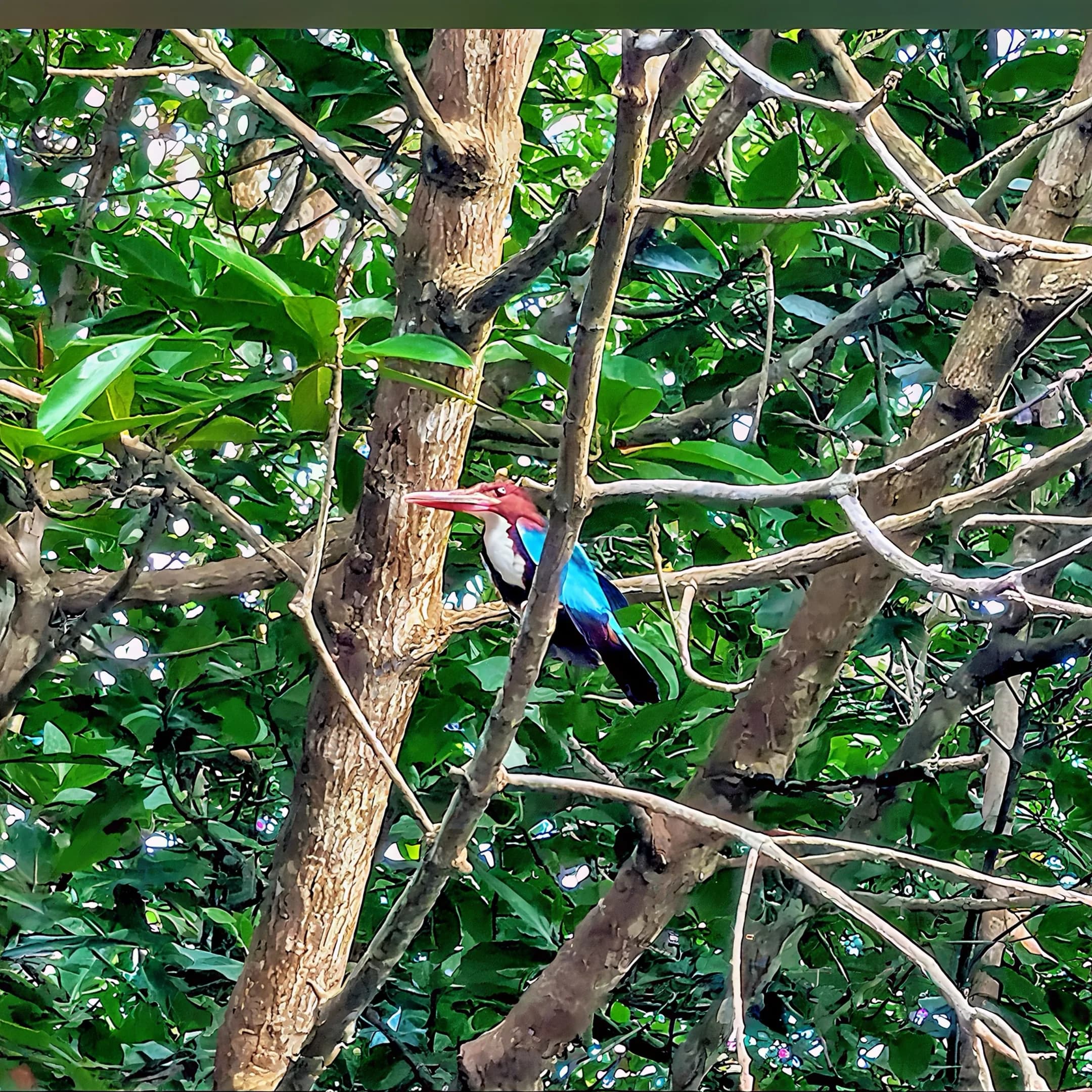
White-throated Kingfisher (Halcyon smyrnensis)
The most colourful of the three. Turquoise wings, chestnut head and belly, bright white throat patch, red bill. Usually seen outside the mangrove — on power lines near the launch point, on fence posts, or on dead branches overlooking open ground. Also hunts well away from water: lizards, large insects, and small frogs are all prey.
Where: Open areas near the water's edge; perched high on wires or posts
When: All day; unmistakable silhouette
Herons and Egrets
Rathgama's shallow margins and mangrove edge are perfect heron habitat.
Purple Heron (Ardea purpurea)
The largest and most dramatic of the herons on the lake. Slate-grey above, chestnut-streaked below, with a distinctive long neck that folds into an S-shape in flight. Hunts by standing completely motionless at the water's edge for extended periods — sometimes minutes without moving a muscle — before striking at fish with a lightning-fast bill thrust. The Purple Heron's stillness makes it easy to miss until it moves.
Where: Shallow edges of the mangrove channels and open lake margin
When: Most active at dawn; also present at dusk
Grey Heron (Ardea cinerea)
Similar to the Purple but larger, paler, and with more uniform grey plumage. More tolerant of open water than the Purple Heron. Often seen standing on exposed sandbars or low mangrove branches over the main lake.
Where: Open water edges and wider channels
When: Throughout the day; less strictly dawn-dependent than Purple Heron
Little Egret (Egretta garzetta)
Brilliant white, with black legs and distinctive yellow feet. Active and mobile — unlike the stationary hunting of the herons, Little Egrets often stir up fish by vibrating their feet in the shallows. Their yellow feet are a reliable field mark.
Where: Very shallow water at channel edges and the lake margin
When: Active throughout the morning
Cormorants and the Oriental Darter
Little Cormorant (Microcarbo niger)
The most common diving bird on the lake. Small, all-black, swims low in the water with its body almost submerged. Dives repeatedly to chase fish underwater. After fishing, comes ashore to dry its wings — this is a defining behaviour, as cormorant feathers are not fully waterproof and need to air dry. Groups of three to ten are common on exposed branches over the water.
Where: Open water and wider channels
When: Active all day; wing-drying in mid-morning sun
Oriental Darter (Anhinga melanogaster)
Also called the "snakebird" — when swimming, only the long, sinuous neck shows above the waterline, resembling a snake moving through water. The Darter is less common than the cormorant but unmistakable when you see it. Like the cormorant, it dries its wings after diving, holding them spread wide in a distinctive crucifix pose.
Where: Open water near floating vegetation
When: Mid-morning; look for the wing-drying posture on exposed branches
Raptors
Brahminy Kite (Haliastur indus)
The lake's signature raptor. Chestnut-brown body with a contrasting white head and breast — visible at great distance. Soars in wide, lazy circles over the open water, watching for fish near the surface. Occasionally snatches prey directly from the water with its feet without fully landing.
Where: Overhead, anywhere above the lake
When: Most visible mid-morning as thermals build; often present from dawn
Osprey (Pandion haliaetus) — October to March only
A migratory visitor from Central Asia and Europe, present on the lake from October through March. Larger than the Brahminy Kite, dark brown above and white below, with a distinctive dark mask. Hovers over the open water before plunging feet-first to grab fish — one of the most spectacular hunting behaviours you are likely to witness on the lake.
Where: Open water sections of the lake
When: Dawn and mid-morning
Water Monitor Lizard (Varanus salvator)
Not a bird, but arguably the most dramatic wildlife encounter on the tour. Water Monitors are large — adults regularly reach 1.2–1.5 metres — and are excellent swimmers. They are also spectacularly indifferent to kayakers at close range, which means you can paddle to within two or three metres of a basking monitor without disturbing it.
Monitors are cold-blooded and need to warm up each morning. The best time to see them is mid-morning on sunny days, when they emerge from the mangrove edge to bask on exposed roots, banks, or fallen logs at water level. From a kayak, you are eye-to-eye with a 1.3-metre reptile — it is genuinely impressive.
Where: Mangrove edge, exposed banks, low rocks near the channel
When: Mid-morning, in sun
Behaviour: Will slide into the water smoothly if approached too closely; no threat to humans
Mammals
Long-tailed Macaque (Macaca fascicularis)
Groups of macaques live in the mangrove forest and are regularly seen in the canopy or at the water's edge. They are opportunistic foragers — they will eat crabs, fruits, leaves, and occasionally raid fishing gear. On the kayak tour, you are most likely to spot them crossing between mangrove trees overhead or drinking at the water's edge.
Where: Mangrove canopy, usually heard before seen
When: Morning, especially within the first hour of the tour
Indian Flying Fox (Pteropus giganteus)
Fruit bats with a wingspan up to 1.2 metres. Roosting colonies hang in large trees near the Island Hermitage — dozens or hundreds of bats visible hanging upside down during the day. At dusk, the colony takes flight in a stream that can last 15–20 minutes. If your tour passes near the hermitage at the right time of day, the roost is unmissable.
Where: Large trees near the Island Hermitage
When: Visible all day at roost; most dramatic at dusk departure
Practical Tips for Wildlife Spotting on a Kayak
Move quietly. Paddle strokes that splash loudly will push birds off their perches before you see them. A smooth, low, silent stroke through the water surface keeps wildlife relaxed.
Stop before you look. If you spot something interesting, stop paddling and let the kayak drift. Movement and noise together are the two things that disturb wildlife; eliminating one helps significantly.
Use binoculars. A small pair of 8x30 or 10x42 binoculars fits in a dry bag and makes the difference between seeing a kingfisher as a blue blur and actually seeing a kingfisher. Compact travel binoculars are easily available in Colombo or Hikkaduwa.
Ask your guide. The AquaTrek guides paddle this lake daily. They know where the kingfisher nest sites are, where the monitor lizards like to bask, and which trees the macaque troop visits each morning. Tell them what you most want to see and they will take you there.
Time of day matters more than season. The first 90 minutes after sunrise accounts for roughly 70% of all visible bird activity. A 6 AM start on any day of the year will show you more wildlife than a 9 AM start in December.
When to Visit for Wildlife
| Season | Wildlife Highlights | |--------|---------------------| | November – February | Most migratory species present; Osprey in residence; clearest water | | March – April | Kingfisher breeding behaviour; intense activity near nest sites | | May – August | Lush green lake; Purple Heron and cormorant most visible; macaque family groups with young | | September – October | First migrants arriving from mid-October; quietest on the lake |
All seasons offer excellent wildlife viewing — the species composition changes but the quality does not. The single most reliable choice is always the Sunrise & Wildlife Tour, regardless of month.