Island Hermitage: A Spiritual Sanctuary on Rathgama Lake
November 5, 2024 · by AquaTrek
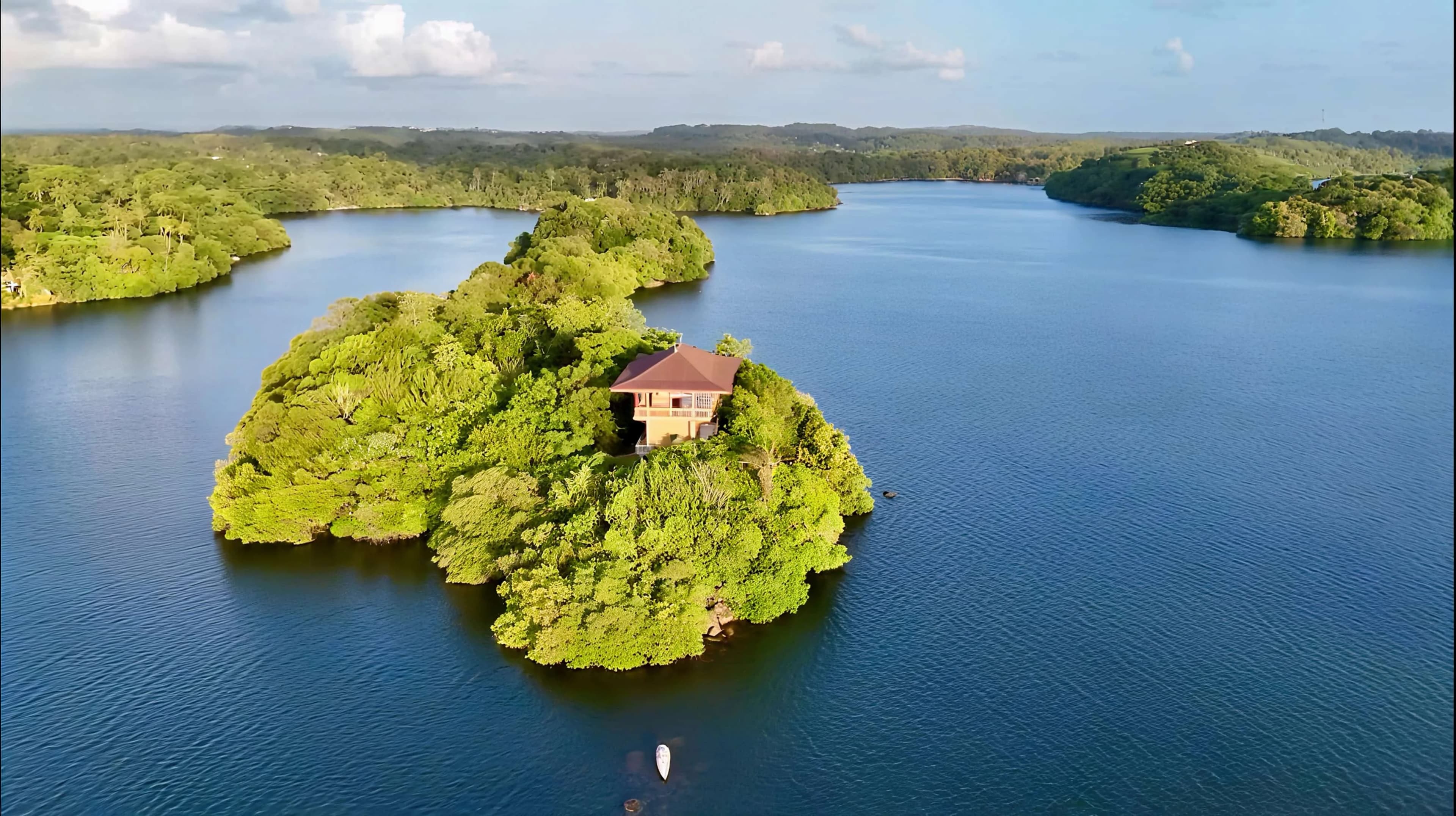
From the lake, the Island Hermitage looks like little more than a dense knot of trees rising from the water — palms, jak fruit, and broad-leafed canopy pressing close over tiled rooftops. Nothing announces its significance from the outside. But this small island, reachable only by boat and sitting about two kilometres from the southern shore of Rathgama Lake, is one of the most historically significant Buddhist monasteries in the modern world.
Anton Gueth and the Founding of a Monastery
Karl Anton Gueth was born in Wiesbaden, Germany, in 1878. A musician and philosopher by training, he encountered Buddhism through the writings of Arthur Schopenhauer and later through the Pali Canon, the scriptural language of Theravada Buddhism. In 1903, he travelled to Burma and was ordained as a bhikkhu — a fully ordained monk — taking the name Nyanatiloka, meaning "knower of the three worlds."
After years of wandering between Ceylon (now Sri Lanka), Burma, and India, Nyanatiloka was offered the island in Rathgama Lake in 1911 by a local patron. The island had a few old structures and enough land for a modest monastery. Nyanatiloka accepted, and the Island Hermitage (Polgasduwa Islandu Aramaya) was established.
The choice of location was deliberate. Rathgama's lake environment — isolated, quiet, surrounded by water — replicated the forest hermitages described in early Buddhist texts. The Vinaya, the monastic code, encourages monks to live in secluded places away from urban distractions. An island on a brackish lake in southern Ceylon, in 1911, was about as secluded as a person could get.
Nyanatiloka's Scholarly Legacy
Nyanatiloka was not merely a monk who happened to be European. He became one of the foremost Western scholars of Pali and Theravada doctrine in the 20th century. His translation of Anguttara Nikaya (one of the five major collections of the Pali Canon) remains a standard reference work. His Buddhist Dictionary — a systematic guide to Pali terms and concepts — went through multiple editions and is still in print today, translated into German, French, Spanish, and other languages.
He also wrote The Word of the Buddha, an anthology of doctrinal passages from the Pali Canon arranged to give a complete picture of the Buddhist path. First published in 1907, it was one of the earliest accessible introductions to Theravada Buddhism in Western languages and influenced a generation of European and American seekers.
The World War Interruptions
Nyanatiloka's time at the Hermitage was not unbroken. As a German national, he was interned by British colonial authorities during both World War I and World War II. During WWI, he was held in Australia after being arrested while on a visit; the community of monks he had gathered at the Hermitage dispersed temporarily. After the war, he returned and re-established the community.
During WWII, internment was again imposed. Nyanatiloka and other German-national residents of the Hermitage were held in camps in India. By this time the Hermitage had attracted a small international community, and the war years scattered its monks across the region. After 1945, Nyanatiloka returned for the final time and continued his teaching and writing until his death in 1957.
He is buried on the island. His samadhi — the memorial structure marking his resting place — remains on the grounds today.
Notable Monks Who Trained at the Hermitage
The Island Hermitage attracted several monks who would go on to become significant figures in the transmission of Theravada Buddhism to the West.
Nyanaponika Thera (Siegmund Feniger, born Frankfurt, 1901) arrived at the Hermitage in 1936 and became one of Nyanatiloka's most distinguished pupils. His book The Heart of Buddhist Meditation, published in 1954, introduced satipaṭṭhāna vipassanā meditation practice to a wide Western audience and is considered a foundational text in the modern mindfulness movement. He spent decades at the Hermitage and died in Sri Lanka in 1994.
Ñaṇavīra Thera (Harold Musson, born Aldershot, 1920) was a British officer who resigned his commission, encountered Buddhism in Italy, and came to the Hermitage in 1949. He was ordained by Nyanatiloka and later moved to a forest hermitage in Bundala, where he underwent a prolonged solitary retreat and composed Notes on Dhamma — a dense, unconventional commentary on Pali doctrine that developed a devoted following, particularly among analytically minded readers. His letters, collected as Clearing the Path, remain widely read.
Ñāṇamoli Thera (Osbert Moore, born Bristol, 1905) arrived at the Hermitage in 1949, the same year as Ñaṇavīra. A former BBC radio producer, he became one of the most prolific translators of Pali into English, producing a complete translation of the Majjhima Nikaya, the Visuddhimagga (the fifth-century meditation manual by Buddhaghosa), and numerous other texts. He died suddenly in 1960 while walking in Sri Lanka, his translations unfinished; they were completed and published posthumously.
The Monastery Today
The Island Hermitage continues to function as a Theravada monastery. Resident monks follow the traditional bhikkhu routine: predawn waking, morning alms round in Rathgama town (by boat), study, meditation, and minimal personal possessions. Visitors are welcome on the island but the community requests appropriate dress — shoulders and legs covered — and quiet behaviour.
The grounds include the old kutis (meditation huts) built on stilts over the water or set back among the trees, the sīma (the formally consecrated boundary used for ordination ceremonies), a library containing Nyanatiloka's original manuscripts and a significant collection of Pali texts, and the memorial structures for Nyanatiloka and other elders.
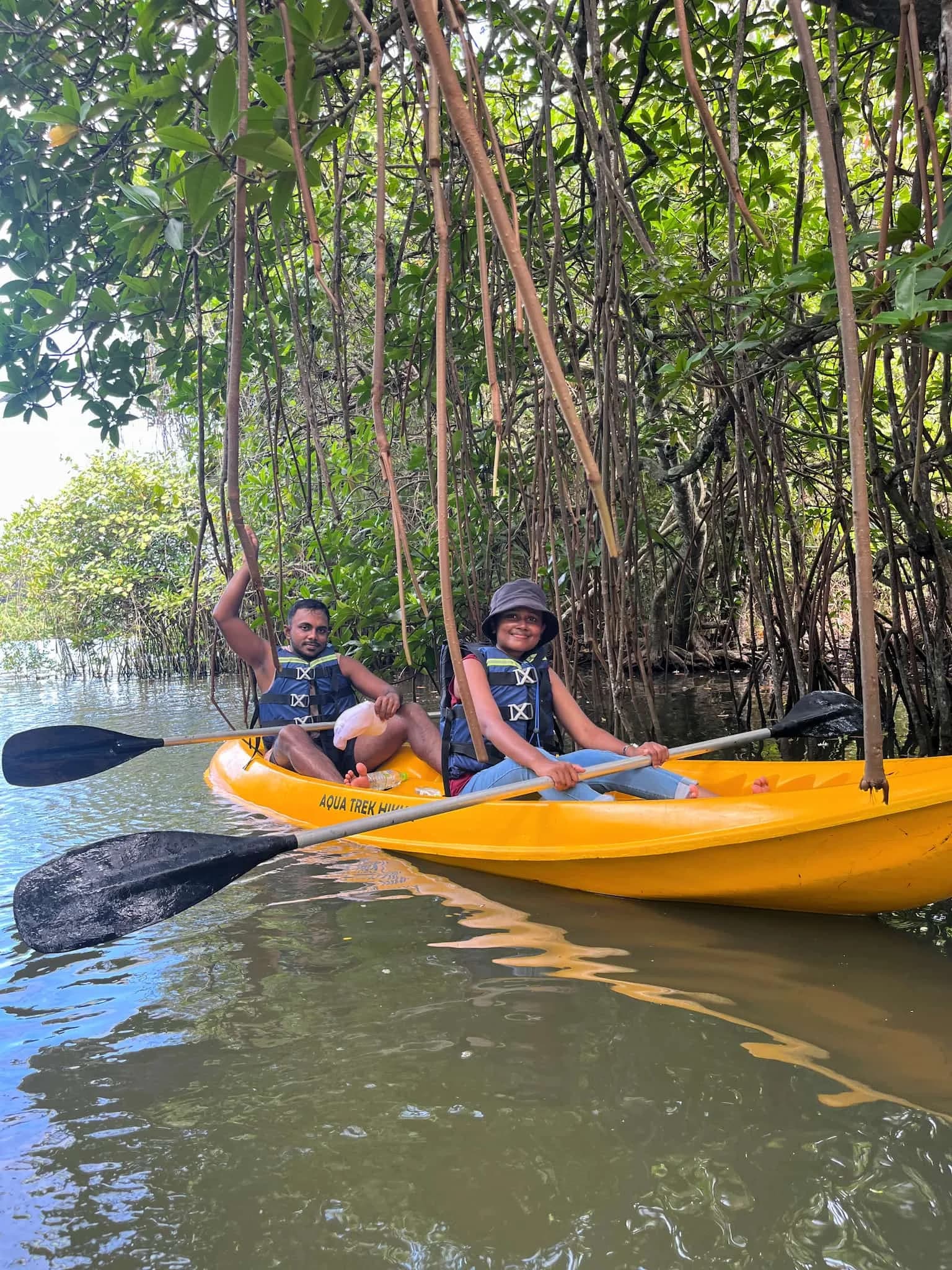
What strikes most visitors is the quiet. Even in November, when the surrounding lake is active with fishing boats and tourist kayaks, the island itself feels unhurried. The trees are old — jak, breadfruit, coconut, frangipani — and the paths between kutis are swept daily. It is a working monastery, not a heritage site.
Reaching the Island
The Island Hermitage is accessible by boat from Rathgama town or from the southern shore of the lake. The crossing takes about 10 minutes. Our kayak tours pass close to the island's shoreline, and guests often ask to pause here — the sight of the old rooftops through the trees and the knowledge of who has walked these grounds is quietly affecting.
We do not enter the monastery grounds during regular tours out of respect for the community's schedule, but for guests who wish to visit formally, the island receives visitors on most mornings.