Buddhist Monasteries of Sri Lanka's Southern Coast
May 11, 2026 · by AquaTrek
Buddhism arrived in Sri Lanka around 250 BCE, brought by the monk Mahinda — son of the Indian emperor Ashoka — who landed on the Mihintale rock north of Anuradhapura and converted King Devanampiya Tissa. The tradition that took root was Theravada Buddhism, the oldest surviving school, which holds that the Pali Canon preserves the earliest and most accurate record of the Buddha's teachings.
For 2,300 years, Sri Lanka has been one of the two or three most important centres of Theravada Buddhism in the world. The island is home to one of the oldest human-planted trees with a verified historical record — a branch of the original Bodhi tree under which the Buddha attained enlightenment, brought to Anuradhapura by Sanghamitta in 249 BCE, and still alive today.
The southern coast is not where the great ancient capitals were built — those are in the north-central plains at Anuradhapura and Polonnaruwa. But the south has its own tradition of Buddhist practice, quieter and less visited, concentrated in cave temples carved from granite outcrops, island monasteries surrounded by lagoon water, and forest hermitages where the connection to early Indian Buddhist practice is still visible.
The Island Hermitage, Rathgama Lake
The most unusual Buddhist institution on the south coast sits on an island in the middle of Rathgama Lake, accessible only by boat: the Island Hermitage (Polgasduwa Aranya Senasana), founded in 1911 by the German-born monk Nyanatiloka Mahathera.
Nyanatiloka — born Anton Gueth in Wiesbaden in 1878 — became the first German to be ordained as a Theravada Buddhist monk. He arrived in Sri Lanka after a wandering period of study in Asia, purchased the island in the lake, and established a small monastery specifically designed as a retreat for Western monks who wished to practice in the original Theravada tradition without adaptation to Western culture. The monastery's founding principle was strict Vinaya practice — the original monastic code established by the Buddha — combined with physical isolation from ordinary social life, enforced by the lake.
The hermitage became one of the most intellectually significant Buddhist institutions of the 20th century. Nyanatiloka attracted students from Germany, England, America, and elsewhere. Among them was Nyanaponika Thera (also German-born), who went on to found the Buddhist Publication Society in Kandy, one of the most important publishers of Theravada texts in English. The accumulated library on the island includes manuscripts and translations that shaped how the Western world came to understand Pali Buddhism.
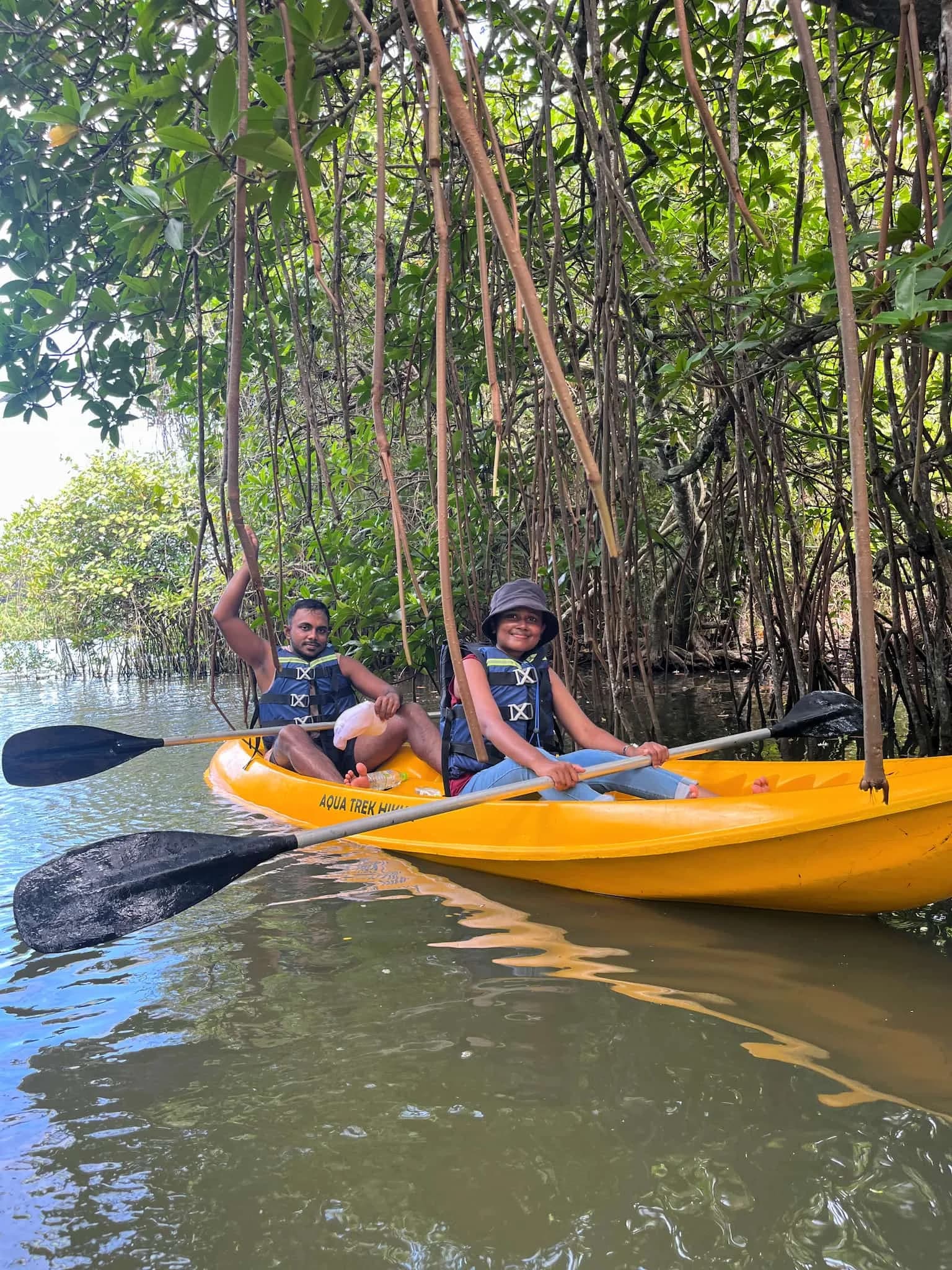
The monastery is still active. Monks resident today continue the practice of strict Vinaya monasticism and the tradition of rigorous scholarship in Pali texts. The island is not generally open to casual visits — it is a functioning monastery, not a tourist site. But the hermitage is clearly visible from the water, and paddling past it on the Rathgama sunrise kayak tour, the robed monks moving quietly on the shore, is an encounter with an institution of genuine historical significance.
For those interested in visiting respectfully: contact the monastery directly, arrive modestly dressed (shoulders and knees covered), and understand that access is at the monks' discretion and depends on whether they are observing retreat periods.
Mulgirigala Rock Temple
Roughly 65 kilometres east of Hikkaduwa, above the town of Mulgirigala in the Hambantota district, an extraordinary complex of cave temples climbs a granite outcrop rising 200 metres above the surrounding plain. Mulgirigala is one of the oldest Buddhist sites in Sri Lanka, with inscriptions dating some caves to the reign of King Kavantissa in the 2nd century BCE.
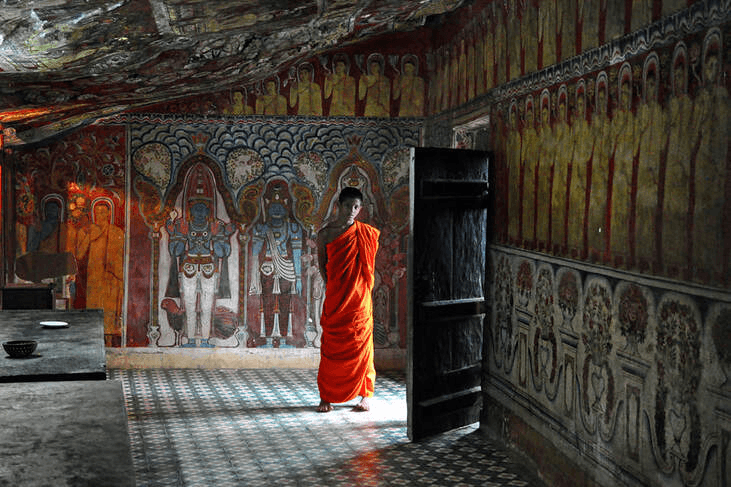
The site consists of seven caves arranged on three terraces cut into the rock face, reached by a stone staircase carved into the cliff. Each cave contains reclining and seated Buddha images — some carved from the living rock, some constructed — surrounded by murals. The murals in the lower caves date primarily from the 17th and 18th centuries, repainted over earlier versions, and depict scenes from the Jataka tales: the past lives of the Buddha. The style is immediately recognisable as Kandyan, with flat, stylised figures in orange, red, and green against cream backgrounds.
The upper cave, reached by the final section of the staircase, contains what may be the most significant historical object at Mulgirigala: a set of palm-leaf manuscripts found here in 1826 by a British civil servant named George Turnour. The manuscripts turned out to be an important portion of the Mahavamsa, the Pali chronicle of Sri Lankan history begun in the 6th century CE. Turnour's translation of the Mahavamsa, published in 1837, was the first scholarly reconstruction of early Sri Lankan history and remains foundational. The manuscripts he found at Mulgirigala helped establish the dates of events in both Indian and Sri Lankan history.
The practical experience of visiting Mulgirigala: a steep but manageable climb (allow 45 minutes up and down), near-total absence of other tourists on most days, and from the summit a panoramic view of the southern interior — flat agricultural plain in every direction, the coast visible as a bright line in the distance. The cave interiors are cool, the images well-preserved, and the site genuinely impressive in scale.
Getting there: 65 km from Hikkaduwa, approximately 1.5 hours by car. A half-day trip is possible from Hikkaduwa or Galle. Combine with a stop at Weligama or Mirissa if travelling east along the coast.
Kataluwa Purvarama Temple
On the inland side of the coast road between Galle and Hikkaduwa, hidden down a dirt lane through a coconut estate, is Kataluwa Purvarama — a temple that most visitors to the south coast pass within a few kilometres of without knowing it exists.
The temple complex is old — parts of it date to the 18th century — but what makes it worth seeking out is the mural cycle in the main image house. Painted in the Kandyan style of the 19th century, the murals cover every surface: ceiling, walls, and the space above the doorways. They depict scenes from the life of the Buddha, the Jataka tales, and — unusually — figures of Dutch and Portuguese colonial officials rendered in European dress, shown as part of scenes from Buddhist cosmology.
This is one of the most vivid examples of how Sri Lankan religious art absorbed and processed colonial contact: the foreigners are not shown as enemies or oppressors but as characters in a Buddhist cosmological framework, present in the story because the story is universal. The Dutch officials in their period coats and wigs appear alongside gods, demons, and bodhisattvas, all part of the same pictorial universe.
The temple is active — monks live here, and visitors should behave accordingly. Arrive in the morning for the best light in the image house. Small donation expected; no set entrance fee.
Getting there: Signposted from the coastal road between Galle and Hikkaduwa. Look for the turn approximately 3 km north of Galle Fort, inland side.
Galle's Buddhist Heritage Within the Fort
Galle Fort is famous for its Dutch colonial architecture and its cafés, but it has Buddhist dimensions that predate the European presence. The fort area was settled long before the Portuguese arrived in 1505, and several Buddhist institutions existed here in the pre-colonial period.
Within the fort today, the most significant Buddhist site is the Meera Mosque area — which is primarily Islamic — but adjacent to it is the Sudharmalaya Buddhist Temple, a functioning temple inside the fort walls where the monastic community maintains practice in the midst of a UNESCO heritage zone that is otherwise dominated by boutique hotels and restaurants. The contrast is striking and worth acknowledging: Buddhism, Islam, and the architecture of the Dutch Reformed Church coexisting in a walled city the size of a few city blocks.
The National Museum in Galle Fort (housed in a Dutch warehouse) contains artefacts including ancient Buddhist bronzes, inscribed stones, and items recovered from shipwrecks in the harbour — physical evidence of the trading world that connected Sri Lanka to the rest of the Indian Ocean region.
The Living Tradition: Forest Monasteries
Beyond the historical sites, the southern Sri Lankan interior contains a network of contemporary forest monasteries (aranya senasana) where monks practice in a tradition that traces its lineage back to the earliest period of Sri Lankan Buddhism.
These communities are not tourist destinations — they are active monastic institutions. But for visitors with a serious interest in Theravada Buddhism, Sri Lanka's forest monasteries represent something not easily found elsewhere: a living continuation of early Buddhist practice, in the physical environment — forest, rock, isolation — where that practice was originally developed.
The main lineage of Sri Lanka's contemporary forest tradition traces to Nyanatiloka at the Island Hermitage and to the revival of strict Vinaya practice in the 19th and 20th centuries. The tradition continues at monasteries throughout the southern interior, less visited and less known than the major ancient sites.
A Note on Visiting Buddhist Sites in Sri Lanka
A few practical points for respectful visits:
Dress: Shoulders and knees covered, for everyone. Most sites have wrap cloths available at the entrance for a small fee. Lightweight long linen trousers and a loose shirt are practical for the heat and appropriate everywhere.
Footwear: Remove shoes before entering any temple building, image house, or area marked with a sign. Some sites are bare rock — bring socks if the stone is hot.
Photography: Ask before photographing monks. Generally fine to photograph statues, murals, and buildings. Do not pose for photographs with your back to a Buddha image.
Silence: Maintained in practice areas and image houses. Speaking quietly is appropriate; not speaking at all is better.
Donations: Expected at active temples. Place them at the donation box, not directly with monks. Small amounts — Rs 100–500 — are appropriate.
The southern coast rewards visitors who look past the beach and the fort. The monasteries — island, rock, cave, forest — represent a tradition of extraordinary depth, quietly present in the landscape, available to anyone willing to make a short detour off the main road.