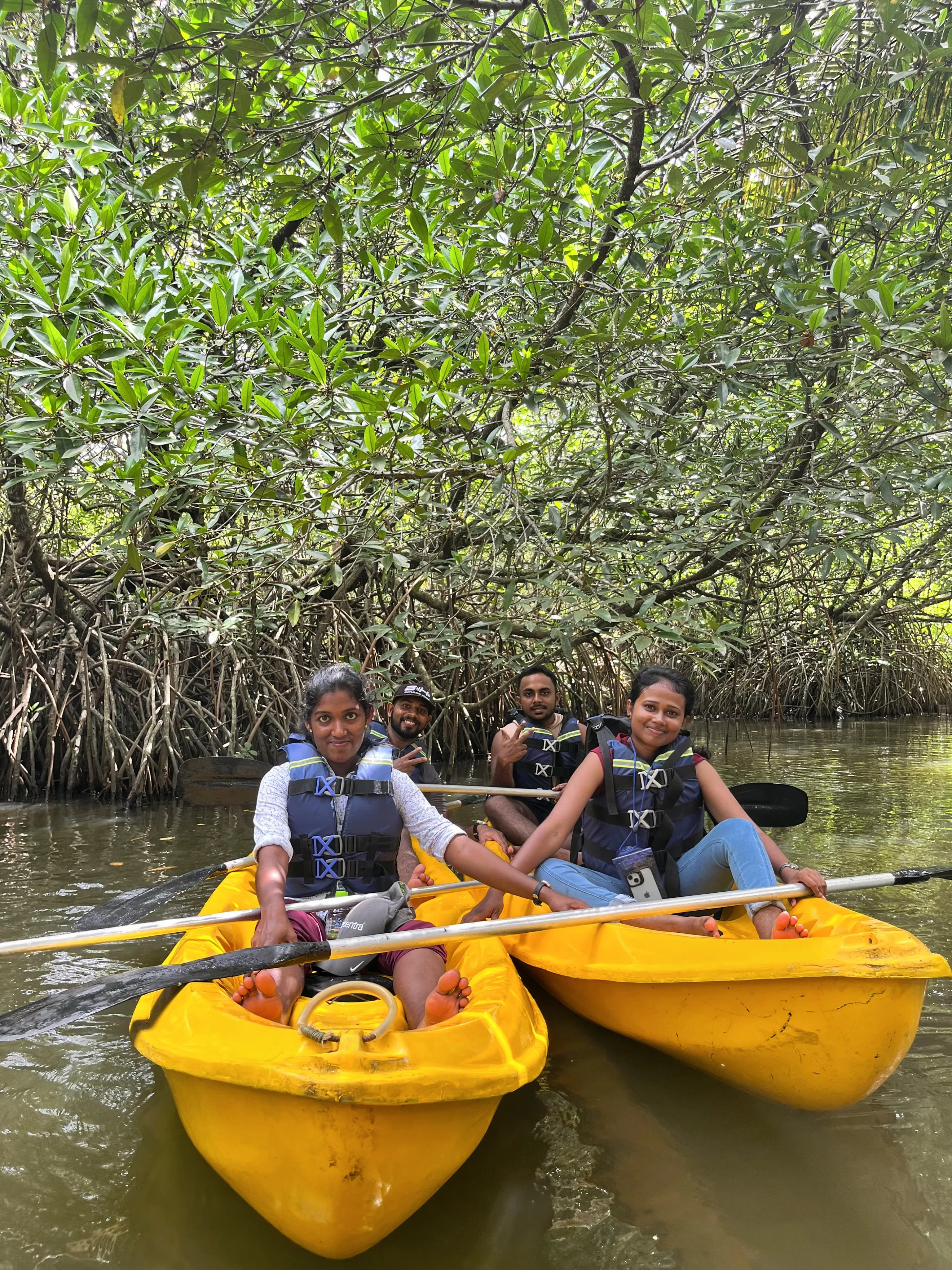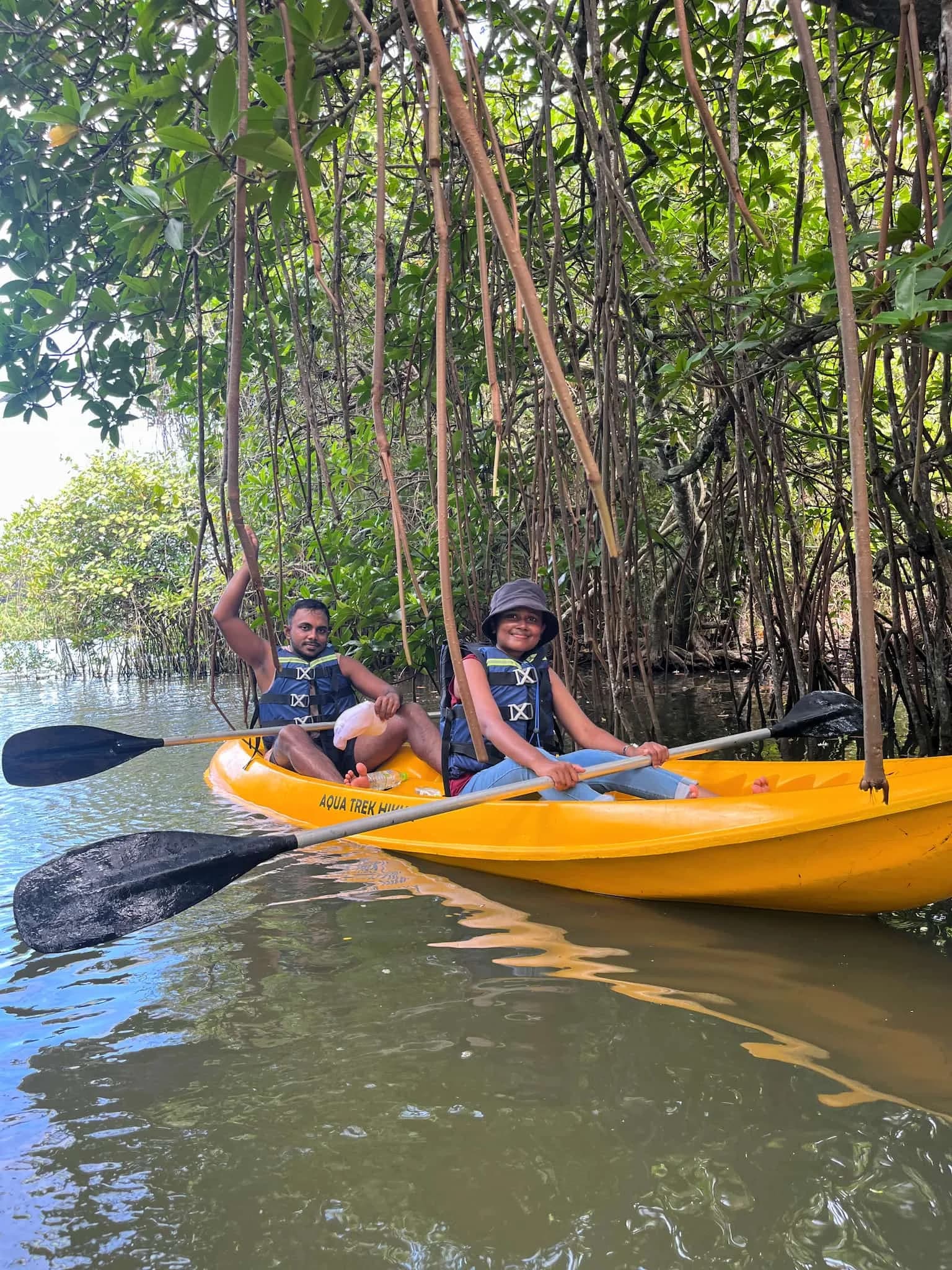
Rathgama Lake's reputation rests on its birds, and rightly so — fifty species on a morning paddle is not unusual. But if you spend a few hours on the water with your attention divided between the canopy and the root systems and the water surface itself, you will find that the lake is far more populated than its birdlife alone suggests.
These are the animals that share the lake with the egrets and kingfishers — the reptiles, mammals, and aquatic creatures that make Rathgama a genuinely multi-taxa wildlife experience.
Water Monitor Lizard (Varanus salvator)
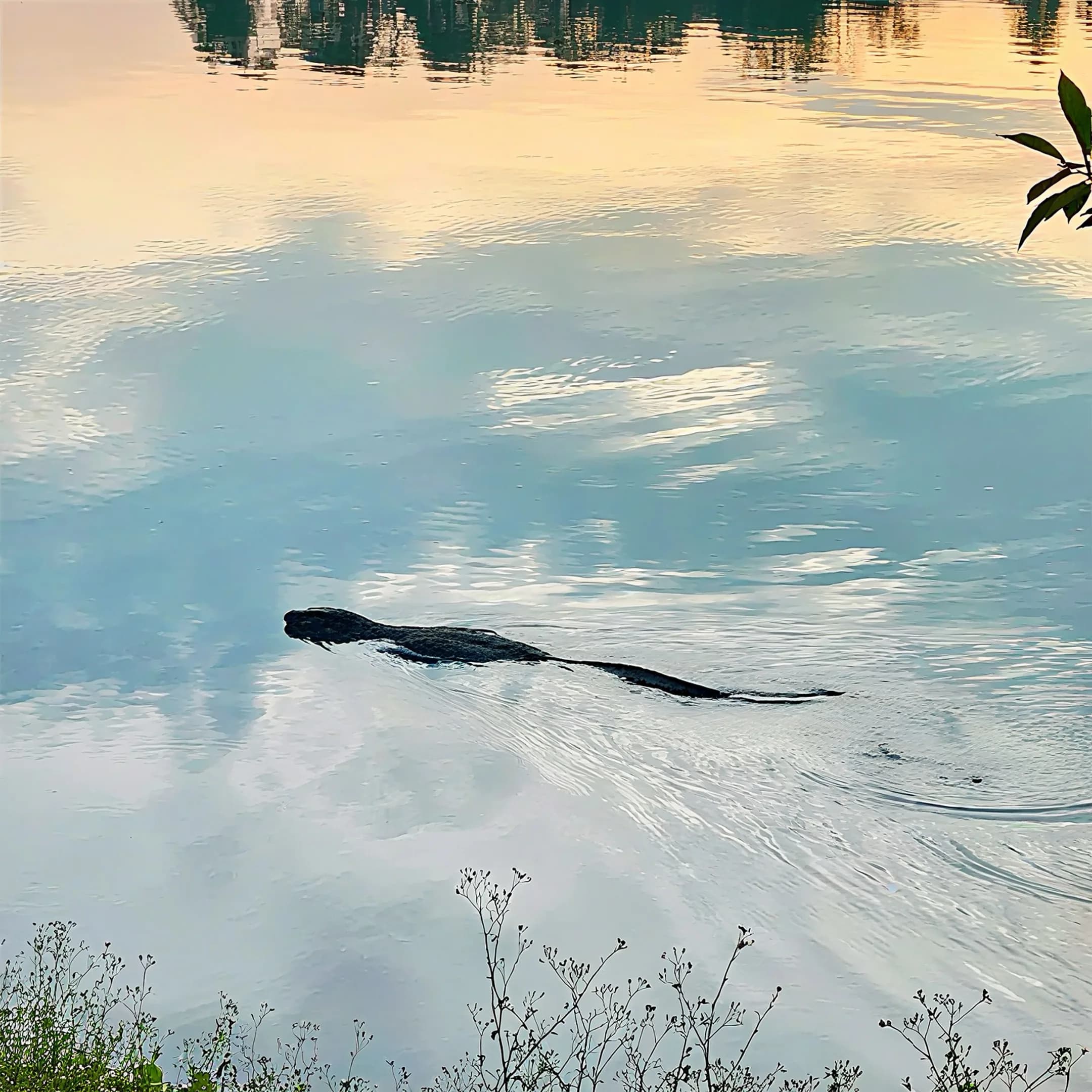
The Water Monitor is impossible to miss if you spend time near the mangrove channels. Sri Lanka's largest lizard — and one of the largest lizard species in the world — the Water Monitor (kabaragoya in Sinhala) can reach 2.5 metres from snout to tail tip and weigh 25 kg, though most adults at Rathgama are in the 1–1.5 metre range.
They are everywhere at the lake's edge: sunning on exposed mangrove roots in the morning, moving along the bank with a low, deliberate swagger, swimming between islands with sinuous, crocodile-like undulation. In the water, the tail becomes a paddle, moving in powerful lateral sweeps while the limbs are held flat against the body. Seeing a large monitor cross a channel — head raised, body rolling rhythmically, covering 30 metres in under a minute — is one of the more quietly impressive sights on the lake.
Water Monitors are opportunistic predators and scavengers. At Rathgama they eat fish, crabs, bird eggs, small mammals, carrion, and invertebrates. They have a forked, blue-black tongue that they use to sample scent particles from the air — the tongue flicks constantly when the animal is alert or moving. Unlike the Komodo Dragon, the Water Monitor's bite was long thought non-venomous; recent research has confirmed it produces mild venom in glands in its lower jaw, though it is harmless to healthy adult humans.
Their relationship with humans in Sri Lanka is complex. The monitor is a protected species under Sri Lankan law, but it is also viewed with ambivalence — some rural communities fear it, others tolerate it, and in some parts of the island it has been hunted for its skin and for folk medicine. At Rathgama, with regular boat traffic and no hunting pressure, the monitors are habituated to human presence and approachable to within a few metres from a kayak.
Fruit Bats / Indian Flying Fox (Pteropus medius)
At dusk, look up. A small colony of Indian Flying Foxes roosts in the tall trees on and around the lake's islands, and as the light fades they unfold from their daytime roosting positions and begin moving across the lake in silhouette against the sky. Their wingspan reaches 1.5 metres — significantly larger than any bird you will see on the lake — and their slow, deliberate flapping is quite different from a bird's wingbeat.
Flying Foxes are not insectivorous bats. They navigate by sight rather than echolocation and feed on fruit, nectar, and pollen. At Rathgama they forage in the jak fruit and mangrove apple trees around the islands, and in the coconut gardens on the lake's northern shore. They are important pollinators and seed dispersers for many tropical tree species — the jak fruit, in particular, relies on them for seed dispersal into the forest interior.
The evening tour offers the best bat viewing: the departure from the roost trees begins about 20 minutes before sunset and peaks at dusk, with animals moving in small groups rather than a single mass exodus.
Toque Macaque (Macaca sinica)
Sri Lanka's endemic Toque Macaque — named for the distinctive whorl of hair on its crown that resembles a toque cap — is a familiar presence around the lake's shores, particularly in the coconut gardens. They are smaller and more lightly built than the macaques you might have seen in India or Southeast Asia, with bright pink faces and amber-brown coats.
The troop at Rathgama moves between the coconut palms, the vegetation bordering the lake's northern shore, and the trees of the islands. They are social, noisy, and highly watchable — adult males make dramatic leaps between palm crowns, juveniles play in the canopy, and the troop's matriarchs (females retain position by age and relationship rather than size) make foraging decisions that the whole group follows.
Toque Macaques are omnivores: fruits, shoots, insects, eggs, and small vertebrates. At Rathgama they raid coconut palms for tender shoots and visit the shoreline for crabs and invertebrates exposed at low tide.
They are endemic to Sri Lanka — found nowhere else in the world — and have been the subject of long-term behavioural research at Polonnaruwa, where a study site has been active since the 1970s. The Rathgama population is smaller and less studied, but the troop structure and behaviour are identical.
Purple-faced Langur (Semnopithecus vetulus)
The Purple-faced Langur (kalu wandura — "black monkey") is quieter and more cryptic than the macaque, moving through the high canopy of mature trees with long, deliberate leaps. It is a large, dark grey-to-black leaf monkey with a noticeably bare purple-black face. Adults have long tails carried in a characteristic upward curve.
This species is endemic to Sri Lanka and classified as Endangered, with its population declining due to habitat loss. The remaining stands of mature trees around Rathgama Lake — particularly the large jak fruit and breadfruit trees around the island hermitage and the southern shore — provide essential corridor habitat for the local population.
Unlike macaques, langurs are predominantly folivorous (leaf-eating) and are rarely seen on the ground. They are harder to spot than macaques, but the sight of a large adult leaping between canopy crowns is unmistakable. Guides know the specific trees where they most reliably shelter.
The Aquatic Life: Mudskippers, Crabs, and Fish
The water's edge and exposed mud flats at low tide host a fascinating community of creatures that most visitors overlook because they are not looking at the right scale.
Mudskippers (Boleophthalmus boddarti and Periophthalmus species) are gobies that have evolved the ability to breathe air, move across mudflats on modified pectoral fins, and even climb mangrove roots. They spend large portions of their time out of water, returning to shallow burrows or tidal pools to keep their skin moist. The sight of a fish dragging itself across mud or sitting upright to survey its territory challenges the intuition that fish belong in water.
Fiddler Crabs (Uca species) are the mudflat's most theatrical residents. Males carry one grossly enlarged claw — often orange or red — that may account for half the crab's total weight. The large claw is useless for feeding (only the small claw handles food) and exists entirely as a display structure: it is waved rhythmically to signal territory and attract females. You will see dozens of males along any exposed mudflat, all waving in desynchronised unison. When disturbed, they retreat to burrow entrances and hesitate before disappearing — brave enough to watch for 15–20 seconds before dropping in.
Mud Crabs (Scylla serrata) are the lake's commercially important large crab, reaching the size of a dinner plate. They are usually hidden under mangrove root undercuts or in burrows, and rarely seen except when a local fisher is pulling a crab trap.
Mullet school visibly in the shallows during incoming tides, their dorsal fins breaking the surface. In clear-water shallows, you can sometimes see the entire shoal change direction simultaneously in a fluid, synchronized turn.
Mangrove Whipray (Urogymnus granulatus) is occasionally encountered in the deeper channels near the lake's outlet. A relatively small ray, it rests on sandy patches between mangrove root systems. Our guides have seen juveniles in the inner channels during rising tides in the dry season months.
Watching Responsibly
The wildlife at Rathgama has become habituated to kayaks partly because kayaks are quiet and low-profile, and partly because they represent no historical threat. Maintaining this habituation requires restraint: paddling slowly, keeping noise minimal, not approaching nesting sites, not feeding animals.
Water Monitors will retreat if approached quickly. Langurs vanish into the canopy at sustained human attention from below. Flying Foxes are disturbed by noise under their roost trees — worth knowing for the dusk tour.
The principle our guides follow: the encounter is better if the animal continues what it was doing. A monitor that keeps basking while you drift close is a better encounter than one that drops into the water because you paddled too aggressively. Patience is the core skill.