Bird Watching Guide: Rathgama's Feathered Friends
November 20, 2024 · by AquaTrek
Rathgama Lake is one of Sri Lanka's most rewarding birdwatching destinations — and one of its least crowded. The combination of brackish open water, mangrove channels, reed beds, and surrounding coconut gardens creates a mosaic of micro-habitats that supports an extraordinary variety of species throughout the year. Whether you carry a field guide and binoculars or simply want to appreciate the wildlife from a kayak, the lake offers encounters that stay with you.
The Kingfisher Family: Three Species in One Paddle
Rathgama Lake is arguably the best place in southern Sri Lanka to see multiple kingfisher species on a single morning. Three species are reliably present year-round.
The White-throated Kingfisher (Halcyon smyrnensis), also called the White-breasted Kingfisher, is the most commonly seen. Vivid turquoise-blue on the back and wings, with a rich chestnut head and body and a brilliant white throat, it is unmissable. It favours exposed perches — low branches, fence posts, or mooring ropes — from which it drops onto fish, frogs, and even large insects. Its loud, descending call is one of the defining sounds of the lake.
The Common Kingfisher (Alcedo atthis) is smaller — about 17 cm compared to the White-throated's 28 cm — and shimmers electric orange and blue in good light. It prefers overhanging branches just above the waterline and plunge-dives headfirst from a height of as little as 20 cm. Spot it by its high-pitched, rapid whistle.
The Stork-billed Kingfisher (Pelargopsis capensis) is the giant of the family, reaching 38 cm, with an enormous coral-red bill. Solitary and shy, it announces itself with a loud, machine-gun cackle before retreating into the mangrove canopy. Finding one perched is a genuine highlight.
Herons, Egrets, and Night Herons
Wading birds are abundant throughout the lake. The Purple Heron (Ardea purpurea) is a regular sight, its long slate-grey and chestnut neck folded into an S-shape as it stalks fish in the shallows. At rest it blends remarkably well into the reeds. The Grey Heron (Ardea cinerea), slightly larger and uniformly grey with a black eye stripe, prefers open water and mudflats near the lake's mouth.
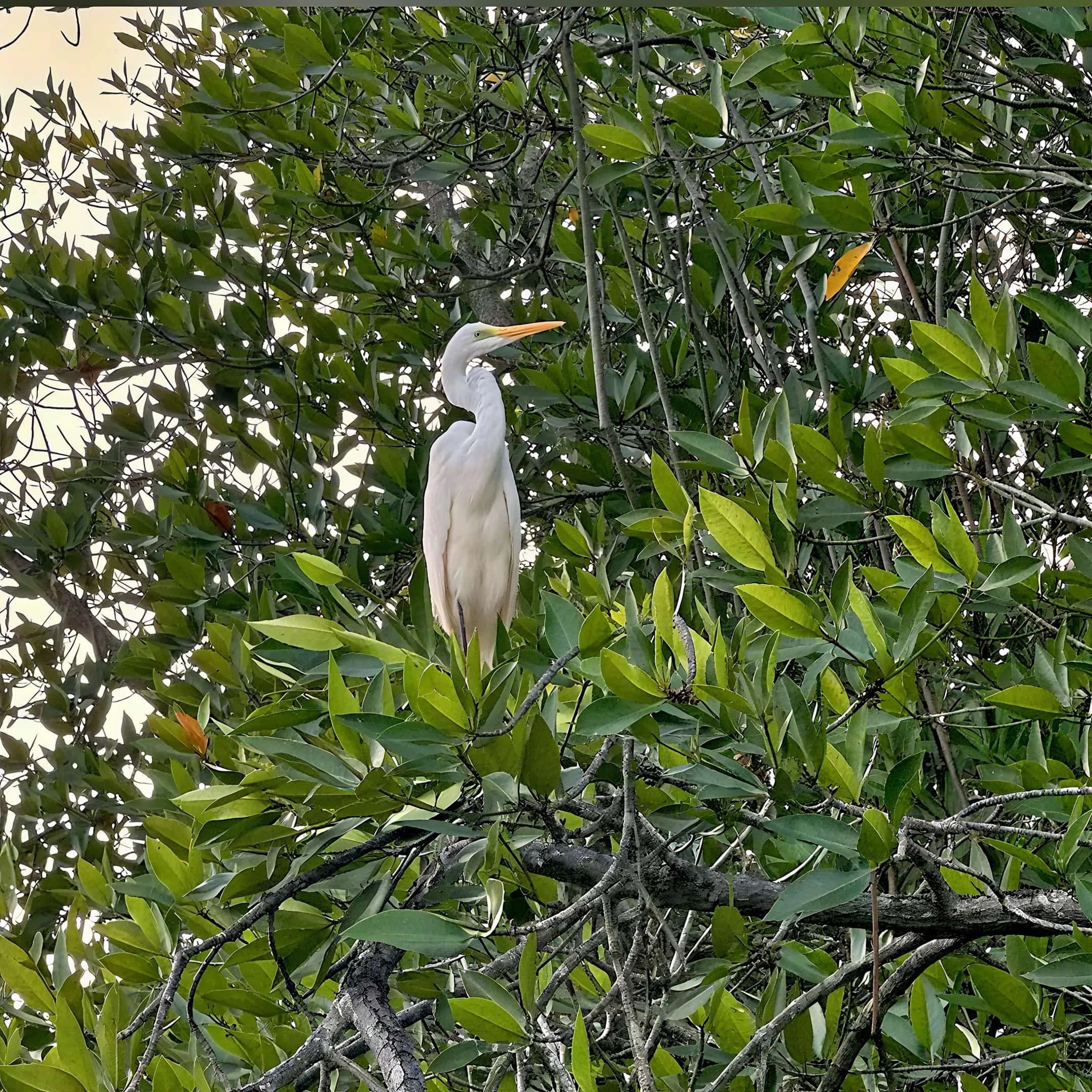
Look low on the banks for the Indian Pond Heron (Ardeola grayii), called the paddybird locally. Hunched and cryptically patterned, it seems unremarkable until it takes flight — at which point its white wings flash brilliantly. The Little Egret (Egretta garzetta), all white with distinctive yellow feet and a black bill, moves delicately along shallow edges. Its larger relative, the Great Egret (Ardea alba), is identifiable by its much larger size and the yellow bill it carries outside breeding season.
As dusk settles, Black-crowned Night Herons (Nycticorax nycticorax) emerge. Stocky and short-necked, with a black cap and back contrasting against a grey-white body, they roost in mangrove trees during the day and become active at sunset — making them an unmistakable feature of the evening tour.
Raptors Overhead
The Brahminy Kite (Haliastur indus) is the lake's most charismatic raptor. Chestnut on the body and wings, with a stark white head and breast, it soars over open water on arched wings, scanning for fish and carrion. It is a sacred bird in Hindu tradition, associated with Garuda. You will reliably see two or three on any morning tour.
The White-bellied Sea Eagle (Haliaeetus leucogaster), one of Asia's most impressive birds of prey with a wingspan reaching 220 cm, is an occasional visitor — often seen perched on tall coconut palms near the lake's southern end or soaring in wide circles.
Cormorants and Darters
Little Cormorants (Microcarbo niger) are a constant presence — small, dark, and purposeful, diving repeatedly after fish before spreading their wings on a branch to dry (they lack the waterproofing oils of ducks). The Oriental Darter (Anhinga melanogaster) swims with only its long, kinked neck above the surface, earning it the name snakebird. Watch it spear fish with a rapid, stabbing thrust.
Migratory Visitors: November to March
Between November and April, Rathgama Lake receives a significant influx of migratory waders and shorebirds. Common Sandpipers (Actitis hypoleucos) bob nervously along muddy banks. Little Ringed Plovers (Charadrius dubius) and Common Redshanks (Tringa totanus) work the shallower edges. Whimbrels (Numenius phaeopus) probe the mud with their long, decurved bills.
Lesser Whistling Ducks (Dendrocygna javanica), though resident year-round, gather in larger flocks during the cool months — sometimes 50 or more in a single tree roost over the water.
Tips for Better Birdwatching
Arrive at first light. The period from sunrise to 9 AM accounts for around 70% of all bird activity. Feeding is intense, territorial calls are strongest, and the low angle of light adds dimension and colour to every sighting.
Paddle slowly and quietly. A kayak lets you approach birds far more closely than a motorboat — often to within 10–15 metres without causing alarm. Keep your paddle movements smooth and avoid sudden hand gestures.
Watch the tree lines. Many species — kingfishers especially — favour exposed perches at forest edges rather than open water. Scanning the mangrove canopy at the edge of the channels rewards patience.
Bring binoculars. An 8×42 pair is ideal: compact enough for a kayak, powerful enough to identify a distant bird clearly. A waterproof case or dry bag is essential.
Our guides have spent years on this lake and can identify most species by call alone. On the sunrise tour, expect to encounter 20–35 species on an average morning.